


The success of a crop season largely depends on the plant’s ability to absorb nutrients, whether they are naturally present in the soil or supplied through fertilization. However, in the Iberian Peninsula—and specifically within the Ebro Valley and Lleida regions—nutrient lockout due to soil pH is a frequent challenge. In this context, chelates emerge as the essential solution to ensure that micronutrients actually reach the root system.
Throughout this article, we will analyze what chelates are, the current reality of soil types in Spain, the most common nutrient deficiencies, and how to adjust fertilization strategies based on soil pH.
What are chelates and how do they act in the soil?
Chelates are chemical compounds in which a metallic micronutrient—such as iron, zinc, manganese, or copper—is surrounded by an organic molecule called a chelating agent. This structure acts as a form of ‘protection,’ preventing the nutrient from reacting with other soil elements that could otherwise immobilize it.
Under normal conditions, particularly in soils with a high pH, many of these micronutrients tend to precipitate into insoluble forms. This means that, even if they are present in the soil, the roots cannot absorb them. Agricultural chelates, however, keep these nutrients in a soluble and available form, facilitating their uptake by the plant.
This capacity is especially relevant in the case of iron, whose deficiency causes the well-known iron chlorosis—one of the most common challenges in Mediterranean crops.
The importance of soil pH in nutrient availability
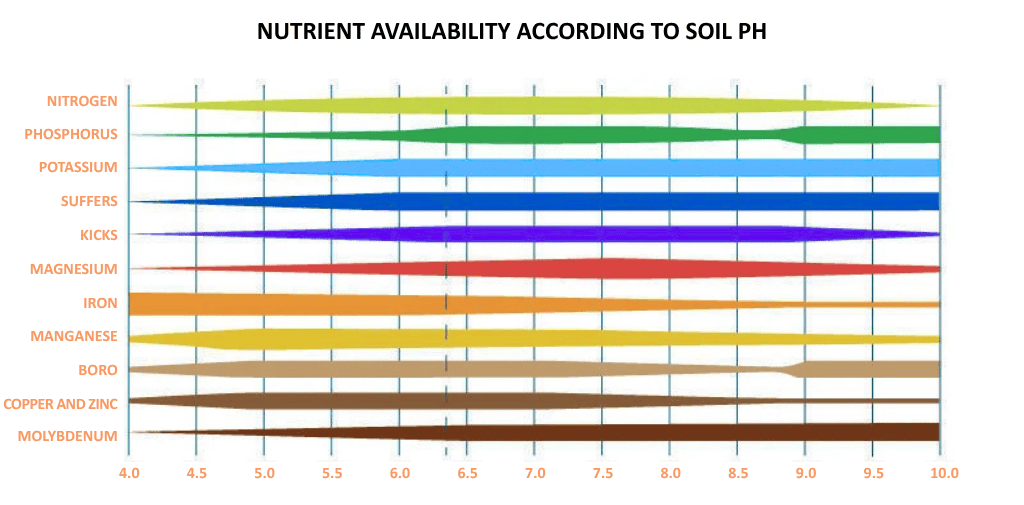
Soil pH is arguably the most determining factor in nutrient availability. Even small variations can completely alter the soil’s chemical balance and directly impact crop nutrition.
In high-pH soils, which are common across much of Spain, micronutrients such as iron, zinc, or manganese become insoluble. This process causes nutrient lockout, preventing the plant from absorbing them even if they are present in sufficient quantities.
Conversely, in acidic soils, the challenge is different. In these cases, an excessive availability of certain metals—such as manganese or aluminum—can occur, reaching levels that are toxic to the plant. Furthermore, other essential nutrients like phosphorus become significantly less available.
These limitations make it clear that strategies ensuring nutrient availability regardless of pH are essential. In this regard, chelates offer an effective and technically proven solution.
Soil types in Spain and their agronomic implications
The diversity of soils in Spain is remarkably broad, and each typology presents specific challenges in terms of plant nutrition.
Basic/calcareous soils, predominant in many agricultural areas (Levante, the Ebro Valley, Eastern Andalusia, and La Mancha), are characterized by a pH above 7.5 and a high concentration of carbonates. These conditions trigger the lockout of iron and other micronutrients (Zn, Mn, B), explaining the frequent appearance of chlorosis in crops such as olives, vineyards, and fruit trees.
In contrast, within the acidic soils of the northern and western peninsula (Galicia, Asturias, Extremadura, and parts of Castilla y León), the primary challenge is the toxicity of certain elements and nutritional imbalances associated with a pH below 6.5. While micronutrient lockout is less common here, other limitations arise that can significantly hinder crop development.
Nutrient deficiencies and the role of chelates
Micronutrient deficiencies vary depending on the soil type, but in many cases, they share a common origin: low nutrient bioavailability.
In calcareous soils, iron deficiency is undoubtedly the most significant. It manifests as chlorosis in young leaves and a general reduction in crop vigor. Zinc and manganese deficiencies are also frequently observed.
In acidic soils, the most common deficiencies involve calcium, magnesium, and phosphorus.
Management and fertilization strategies with chelates
The use of chelates must be part of a global fertilization strategy, tailored to the specific characteristics of both the soil and the crop.
In Calcareous Soils: (highly common in the Lleida region), applying high-stability iron chelates—such as those based on EDDHA—is a standard and necessary practice to prevent and correct iron chlorosis. These are typically applied to the soil, often via the irrigation system.
In Leaching-Prone Soils: Such as sandy terrains, it is recommended to use fractionated applications and chelates to minimize nutrient loss and improve overall efficiency.
Foliar Application: In other scenarios, foliar chelate sprays serve as a highly effective complementary tool for rapid deficiency correction, especially during critical growth stages.
When facing nutrient-locking soils as described, we rely on three primary strategies:
pH Modification: the use of chemical amendments (sulfur, acidifying organic matter) or adding acids to irrigation water. This is a long-term solution but is often cost-prohibitive in soils with high buffering capacity, such as those typically found in Lleida.
Foliar Application: applying nutrients directly onto the leaves. This is highly effective for rapid, specific corrections, but it cannot replace root-based nutrition during high-growth stages.
Chelates via Fertigation: this is the most efficient strategy in the current production model. It guarantees a constant supply of protected nutrients delivered directly to the root absorption zone.
Choosing the right chelate based on soil pH
Not all chelates share the same stability, and their effectiveness depends heavily on soil pH.
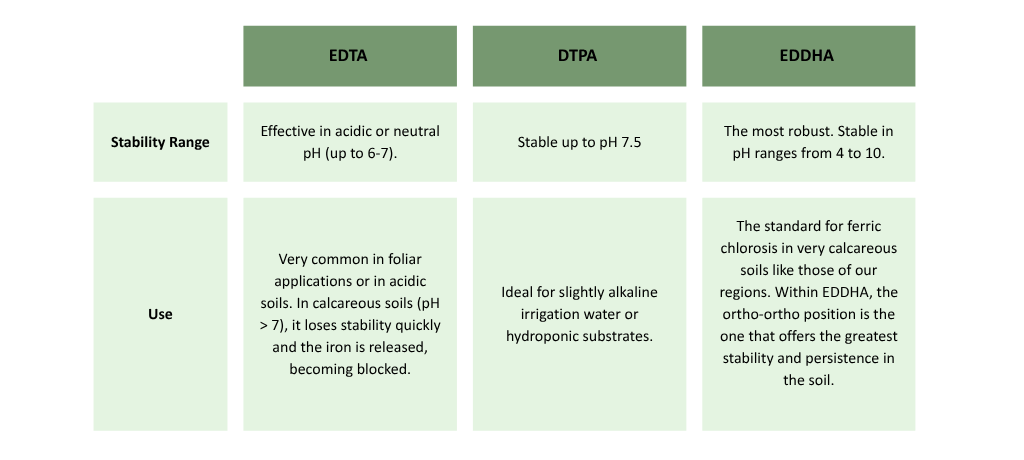
In acidic or slightly acidic soils: Chelates based on EDTA may be sufficient to guarantee micronutrient availability. However, as pH increases, these compounds lose their effectiveness.
In neutral pH conditions: DTPA chelates offer good stability and represent a suitable intermediate option.
In alkaline soils: (such as in the Plana de Lleida), it is essential to use high-stability chelates like EDDHA, particularly for iron. These compounds are capable of keeping the nutrient available even under extremely high pH conditions.
An incorrect choice of chelate can lead to low treatment efficiency and, consequently, the persistence of nutrient deficiencies.
Crop application and impact on productivity
Agricultural chelates have a direct application in numerous crops of high interest in Spain. For example, they are essential for preventing iron chlorosis in calcareous soils. In fruit trees and vineyards, they maintain an optimal nutritional balance and ensure high production quality.
In horticultural crops, where cycles are shorter and nutritional demands are higher, chelates provide a fast and efficient response to any deficiency.
In all cases, their use translates into improved plant vigor, greater nutrient-use efficiency, and ultimately, an increase in yield and final product quality.
The application program should consist of a minimum saturation dose followed by periodic repetitions, as irrigation and rain cause product leaching, reducing its duration of action.
Chelates: the key solution
Chelates have established themselves as an indispensable tool in modern fertilization. Their ability to keep micronutrients available regardless of soil pH makes them a key solution for overcoming nutrient lockout.
In a context like Spain’s, with a widespread presence of calcareous soils, their use is not only recommended but often necessary to guarantee proper crop development.
To achieve the best results, it is essential to base their application on accurate soil analysis and a fertilization strategy tailored to each specific environment.
At Agroborges, we work to provide efficient plant nutrition solutions with a comprehensive range of agricultural chelates adapted to every soil type and crop. Contact our technical team today to optimize your fertilization and enhance the performance of your holdings.
