

Mechanized agriculture as the axis of competitiveness
The Spanish agricultural sector is undergoing an accelerated structural transformation, where mechanized agriculture has established itself not only as an efficiency tool but as a determining factor for the survival and competitiveness of farms in the face of policies that increasingly hinder activity. At Agroborges, we provide an in-depth analysis of this evolution using official data from the Ministry of Agriculture, Fisheries and Food for the 2015-2024 period, to understand how stone fruit has declined in contrast to the rise of almond, irrigated olive, and pistachio crops.
From Stone Fruit to Nuts: The Great Transition Towards Mechanized Agriculture and Technified Irrigation
The agricultural landscape in Spain is changing, and it is not a matter of aesthetics, but of strict economic and operational survival. Over the last decade, we have shifted from a model based on labor intensity to an ecosystem where mechanization and technified irrigation are the sole guarantors of profitability.
Stone Fruit: A Decline in Recent Years
Stone fruit (peach, nectarine, apricot) has been the economic engine of various regions in Spain, such as the Lleida Plains and the Franja. However, the data shows that this engine is losing revs in terms of surface area.
A Sustained Decline in Planted Surface Area
According to official data from the Ministry of Agriculture, Fisheries and Food, peach and nectarine surface area in Spain has seen a decline of approximately 14% over the last decade. Regarding stone fruit, the estimated reduction in planted surface area ranges between 10% and 15% compared to ten years ago*. This decline is not due to a lack of product demand —Spain remains a key player in the European market— but rather a profitability issue. Production costs have skyrocketed while farm-gate prices often do not follow suit, forcing many producers to rethink the continuity of varieties and/or species that require a constant investment in labor that the market does not always return. Furthermore, the continuous withdrawal of active substances makes it impossible to guarantee competitiveness.
The Effect of Climate Change
2022 was a negative year for the sector due to frosts, with results far below normal. Although the 2023-2024 campaigns have shown signs of recovery —with forecasts exceeding 1.4 million tonnes* in the main categories— the crop remains highly vulnerable to weather conditions.
This instability, coupled with increasing administrative pressure, is what deters investment funds and large operators, who seek more predictable business models that are less dependent on climatic ‘luck’ or the availability of seasonal labor.
The Rise of Technified Irrigation: The Olive Orchard as the Spearhead
While stone fruit declines, irrigated olive cultivation is booming. The 2024 ESYRCE (Encuesta sobre Superficies y Rendimientos Cultivos) data reveals a forced trend towards the technification and industrialization of the countryside.
The Expansion of Irrigated Olive Orchards (2015-2024)
In just ten years, irrigated olive cultivation in Spain has grown remarkably:
2015: 748,708 hectares.*
2024: 910,821 hectares.*
Net increase: over 162,000 extra hectares (+10.4%) in a decade.*
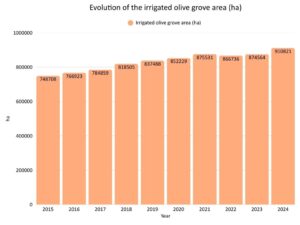
This growth is not only quantitative but qualitative. We are not talking about flood irrigation or traditional methods. Localized irrigation (drip) has risen from 706,687 ha in 2015 to 873,847 ha in 2024. Conversely, gravity irrigation has declined during the same period.
More hectares under localized irrigation equate to total control over fertigation, greater production regularity and, above all, the necessary foundation for mechanized agriculture.
The Super-Intensive Model
Within this new agriculture, the model of densities >1,000 trees/ha (super-intensive or ‘fruit wall’) is what sets the path for new investors. The data shows that 78.35%* of these high-density plantations are under irrigation. It is an inseparable binary: if you want to mechanize with over-the-row harvesters and reduce labor dependency, a ‘fruit wall’ is required, and to maintain a productive ‘fruit wall’, you need water controlled with millimetric precision.
Almond and Pistachio: The New Frontier of Profitability
If the olive orchard represents consolidation, irrigated almonds and pistachios represent aggressive expansion.
Almonds: From Rainfed to Irrigated
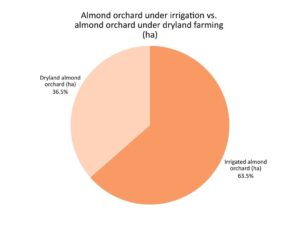
Almonds have ceased to be the ‘marginal crop’ that occupied the corners where water did not reach. In Spain (2024 data), we already have 183,045 ha of irrigated almonds. Although rainfed orchards still dominate in total surface area, abandoned almond groves already stand at around 105,000 ha, indicating that the future of the sector lies exclusively with technified farms that can guarantee constant yields and production in the long term.
Pistachios: The 50/50 That Changes Everything
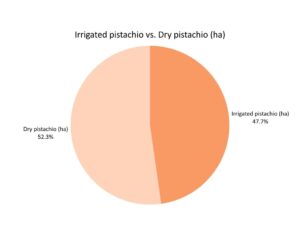
The case of pistachios is perhaps the most striking due to its rapid evolution towards technification. With a total of 83,786 ha*, the crop is already practically split 50/50 between rainfed and irrigated land (40,006 ha irrigated vs. 43,780 ha rainfed*). This balance in a relatively young crop on the peninsula demonstrates that new projects are born directly with a production mechanization mindset.
The Determining Factor: Labor and Administrative Suffocation
Why does a farmer prefer irrigated almond cultivation over peaches? The answer lies in the income statement and personnel management.
Hiring Difficulties: The sector faces a structural barrier in labor availability, exacerbated by rising labor costs and new social regulations.
Added Value vs. Efficiency: Stone fruit certainly generates more added value per hectare, but the operational risk is much higher. Mechanized crops offer an industrialized model for the sector: constant, monitorable and, above all, scalable operations.
The Complexity of the Integrated Farm Record (CIE): For many family farms, the introduction of the CIE is yet another barrier. Bureaucracy is becoming increasingly complex, and many farmers cannot shoulder this level of administrative management on top of the physical labor in the field.
A Change Forced by Pressure
The transition towards crops that allow for lower ratios than those required by stone fruit is not a mere strategic choice, but rather the only remaining path for farmers to maintain competitiveness. Current political decisions, coupled with stifling administrative and labor pressure, leave no room for maneuver. In this scenario, total mechanized agriculture and technified irrigation have ceased to be a modernizing complement and have become the very foundation of the sector’s resilience.
From Agroborges, we encourage you to share your experience: Have you already begun the shift toward more mechanizable models by choice or by necessity? What are the greatest challenges you have faced in managing labor and bureaucracy? Leave a comment and let’s start a conversation.
*Data based on historical series and sectoral reports from the Survey on Crop Surfaces and Yields (ESYRCE) of the Ministry of Agriculture, Fisheries and Food (MAPA), period 2015-2024.
