

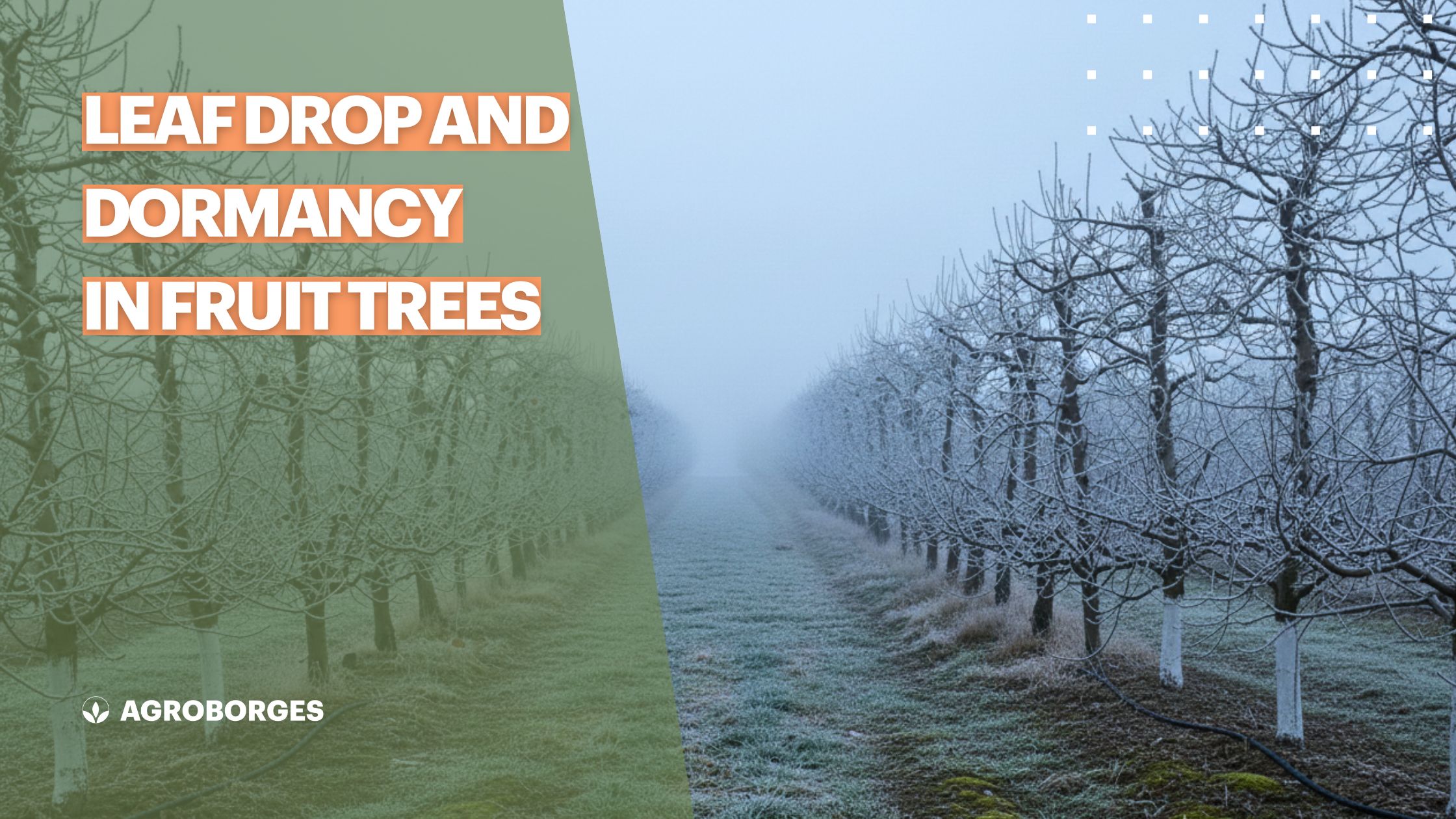
The transition from the productive cycle to winter rest is a critical period for stone fruit trees (Prunus spp.) and pome fruit trees (Malus Domestica, Pyrus Communis). This process, visibly manifested by leaf abscission, culminates in tree dormancy, an essential phase of metabolic lethargy that establishes the foundation for flowering and fructification in the subsequent season.
For growers and agronomic technicians in regions with defined winters, such as the province of Lleida, understanding the mechanisms that regulate these processes and the environmental factors that modulate them is not merely academic; it is the crucial pivot point of agronomic planning for achieving profitable yields. Canopy management and nutrition during this stage must be intrinsically linked to an understanding of winter chilling requirements (chilling hours) and the influence of local variables, such as the persistent fog caused by the characteristic thermal inversion of the Plana de Lleida (Lleida Plain).
The Process of Leaf Abscission and Its Importance
Leaf drop is the most evident sign that the tree is preparing for winter. This phenomenon is not a passive event, but an active and highly regulated physiological process termed foliar abscission. Its primary function is twofold:
Protection: To prevent water loss (transpiration) through the leaves at a time when water uptake from the soil will be drastically reduced or inhibited by low temperatures.
Nutrient Recycling: Prior to separation, the tree mobilizes and stores essential nutrients (primarily nitrogen, phosphorus, and potassium) from the senescing leaves to the branches and trunk for utilization during spring bud break, thereby preventing their loss.
Abscission is primarily mediated by the hormonal balance, specifically the ratio between auxins (which inhibit abscission) and ethylene (which promotes it). As environmental conditions (short photoperiods, low temperatures) signal the onset of winter, auxin production decreases and ethylene production increases in the abscission zone, a specialized layer of cells at the base of the petiole, ultimately causing leaf separation without leaving an open wound.
A late or incomplete leaf drop may be indicative of stress, disease, or inappropriate management (e.g., late nitrogen excess), negatively impacting the induction of dormancy.
Dormancy in Fruit Trees: The Challenge of Chilling Requirements
Dormancy, or endodormancy, is the inability of the bud to grow even if environmental conditions (water, nutrients, temperature) are favorable. It is an evolutionary defense mechanism that prevents premature bud break during a transient warm period in winter.
Dormancy in fruit trees can be divided into three principal stages:
Paradormancy: Growth restriction of the bud due to factors external to the bud itself (such as hormonal inhibitors produced by other parts of the plant or by the leaf itself). It is overcome by leaf abscission.
Endodormancy (True Dormancy): The deepest period of latency. Growth is inhibited by factors internal to the bud itself. It will only be overcome after accumulating a sufficient number of Chilling Hours.
Ecodormancy: The bud has accumulated the necessary chilling to break, but growth is inhibited by unfavorable external environmental factors, such as still-cold winter temperatures. It is overcome when the ambient temperature rises to suitable levels.
To break endodormancy and ensure uniform and adequate bud break and flowering, each fruit variety has a specific genetic requirement for winter chilling. This requirement is quantified in Chilling Hours (CH) or Chilling Units (CU), with the Utah Model being one of the most widely used, as it weights the effectiveness of temperatures (temperatures between 0ºC and 7.2ºC are the most effective, and warm temperatures above 15ºC are inversely proportional, potentially negating previously accumulated chilling hours).
A deficit in chilling accumulation causes: irregular and late bud break (which complicates tasks like thinning and canopy management); scarce and scattered flowering (reducing yield potential); and abnormal leaf development (with rosettes and weak vegetative shoots).
Fog in Lleida: A Critical Factor in Dormancy
The province of Lleida, with its continental climate in the Plana (Plain), presents a climatic particularity in winter: the persistence of fog. This phenomenon, while it may be perceived as a nuisance, plays a significant and complex agronomic role in the phenology of fruit trees.
Direct and Indirect Effects of Fog
- Thermal Moderation and Chilling Accumulation: Fog acts as a “ceiling” that blocks solar radiation and prevents the temperature from rising significantly during the day. This is fundamental for the accumulation of Chilling Units (CU). By constantly maintaining temperatures within the optimal range (0ºC – 7.2ºC), fog minimizes the negative effect of warm hours (>15ºC) which, in a sunny winter, could negate part of the accumulated chill.
- Reduction of Solar Radiation: Fog drastically reduces sunlight, which can influence the residual photosynthetic activity of leaves before abscission and, more critically, may affect the lignification and maturation of the wood for the winter.
Technical Implications and Agronomic Management
For the technician and the grower, the comprehension of these processes translates into specific management decisions.
Management in the Abscission Phase:
Post-Harvest Nutrition: It is vital to apply nutrients (e.g., CaTs®) after harvest and prior to senescence to ensure the plant has resources available for flowering.
Cessation of Irrigation: Gradually reducing or suspending irrigation after harvest facilitates the onset of senescence and the correct induction of abscission.
Autumn Phytosanitary Control: The application of cupric fungicides (e.g., CUPROFLOW®) immediately after leaf drop is the most critical management strategy. The leaf scar wound is a key entry point for pathogens. Copper creates a protective barrier throughout the winter.
Strategies for the Dormancy Phase in Fruit Trees:
Chilling Unit Monitoring: Utilize local weather stations and models (such as the Utah Model or the Dynamic Model) to monitor the weekly accumulation of CU and compare it with the specific requirements of the variety or species.
Intelligent Varietal Selection: In areas of Lleida with a growing risk of chilling deficit due to climate change (especially at higher elevations or areas with less fog), the trend is to incorporate varieties with low and very low chilling requirements.
Use of Dormancy Breakers (Dormancy-Breaking Agents): In years with a confirmed CU deficit, the use of chemical products (such as hydrogen cyanamide, if authorized, or alternatives based on oils and thiourea) allows for more uniform and advanced bud break, mitigating the negative consequences of winter heat.
Leaf abscission and dormancy in fruit trees are two sides of the same coin: the survival and productive potential of the fruit tree. In an environment as specific and productive as Lleida, where winter fog acts as a natural thermal regulator, agronomic management must be a constant alliance between the physiological knowledge of the tree and the attentive observation of the local microclimate. Only through precise management of nutrition and, fundamentally, sanitary protection at the onset of winter, can it be guaranteed that the buds accumulate the necessary chill to awaken vigorously and uniformly, ensuring the profitability of future seasons. Agroborges technicians are specialized in assisting you on your farm and ensuring a successful campaign for 2026. If you wish to receive consultation, please fill out the contact form, and we will respond as soon as possible.
