

The stone fruit campaign in the areas of Lleida and Huesca is a long-distance race where the finish line is not just the harvest, but how the product reaches the end consumer. A piece of fruit that arrives at the cold room with the skin in perfect condition, the pit well-sealed, and a good pulp consistency is the result of a planned fertilization strategy, an appropriate phytosanitary protocol, and a deep knowledge of soil behavior. In this month’s article, we review the key factors that make the difference when it comes to preserving stone fruit.
Calcium: the foundation of preservation
Calcium (Ca) is the star nutrient for preservation. It strengthens the cell wall, provides firmness to the pulp, delays ripening, and reduces sensitivity to post-harvest pathogens such as Monilinia or Botrytis. The logic seems simple: more calcium in the fruit, better preservation.
The problem is that in the soils of the Lleida and Huesca areas —generally basic, with a pH between 8 and 8.5 and a high presence of calcium carbonate— calcium (Ca) exists in abundance within the profile but is poorly available to the plant. At high pH, calcium (Ca) associates with carbonates and forms poorly soluble compounds. Phosphorus (P) suffers the same fate: it precipitates quickly and remains fixed in the soil without reaching the root. We have nutrient-rich soils that are functionally poor: this is the calcium (Ca) and phosphorus (P) blockage in basic soils, one of the most common challenges in fruit growing in our region.
The solution is not always to provide a greater quantity, but to improve availability. In this sense, calcium thiosulfates (CaS2O3) have proven to be a very effective tool. They act in a dual manner: they locally acidify the rhizosphere —reducing the pH around the root— and provide calcium (Ca) in soluble form. Application through fertigation in late autumn (October–November) and early spring (February–March), before the active onset of growth, prepares the soil for the moment when the tree needs it most.
Different Calcium Sources: Which One to Choose?
Not all calcium (Ca) sources provide the same benefit or adapt equally to every situation:
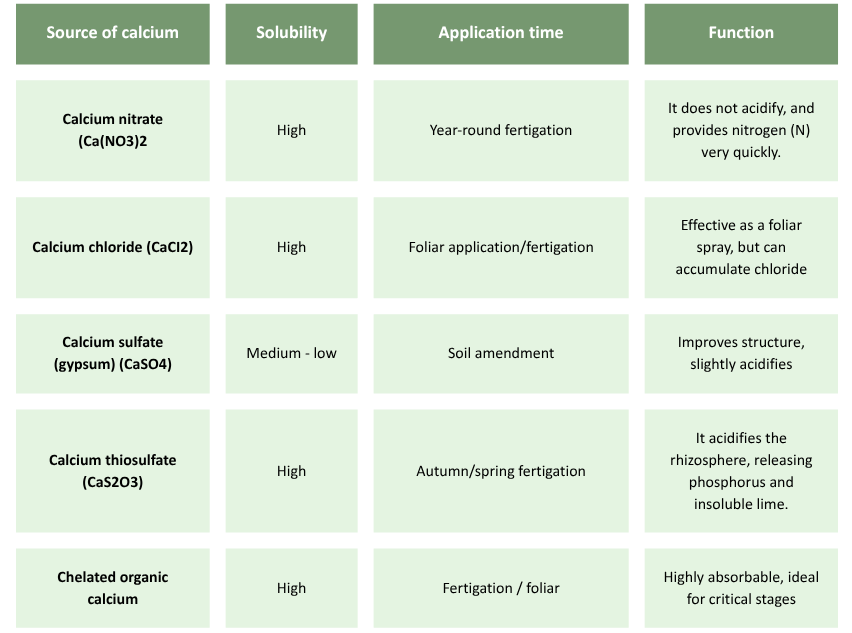
The combination of sources is often the best strategy: calcium thiosulfate (CaS2O3) for soil preparation and foliar chelated calcium (Ca) during periods of cell division.
The calcium (Ca) – potassium (K) ratio: when potassium becomes the problem
Potassium (K) is essential for fruit color, ripening, and quality. However, when applied in excess or at the wrong time, it competes directly with calcium (Ca) for the same root absorption transporters. An imbalanced Ca/K ratio in favor of potassium (K) results in less calcium in the fruit, softer pulp, and shorter post-harvest life.
The trend is clear: avoid high doses of potassium (K) during cell division (from post-flowering up to 30–40 days later) and concentrate potassium (K) applications starting from the moment the pit has hardened and the fruit enters the rapid growth phase. Managing this balance effectively is one of the nutritional decisions with the most direct impact on preservation.
Having calcium (Ca) available in the soil is the starting point, but not the only challenge. Once the tree enters flowering and fruit set, a set of problems appears that manifest directly on the fruit and are often mistaken for isolated or weather-related causes: skin cracking and micro-fissures, a high percentage of fruits with split pits, and weak epidermis that cannot withstand transport or cold storage. These are not independent problems —they are symptoms of the same nutritional imbalance originating during the weeks of peak cell division. Understanding why they occur is the first step toward preventing them.
Cell division and dermal cracking in stone fruit: lecithin as an ally
One of the main causes of micro-fissures and skin cracking in stone fruit is insufficient or imbalanced cell division during the first weeks post-flowering. When the epidermal cells do not multiply in proportion to the internal tissues, the skin cannot “stretch” enough, leading to micro-tears (also caused by osmosis in high humidity) that, although not initially visible, compromise the quality and shelf life of the fruit.
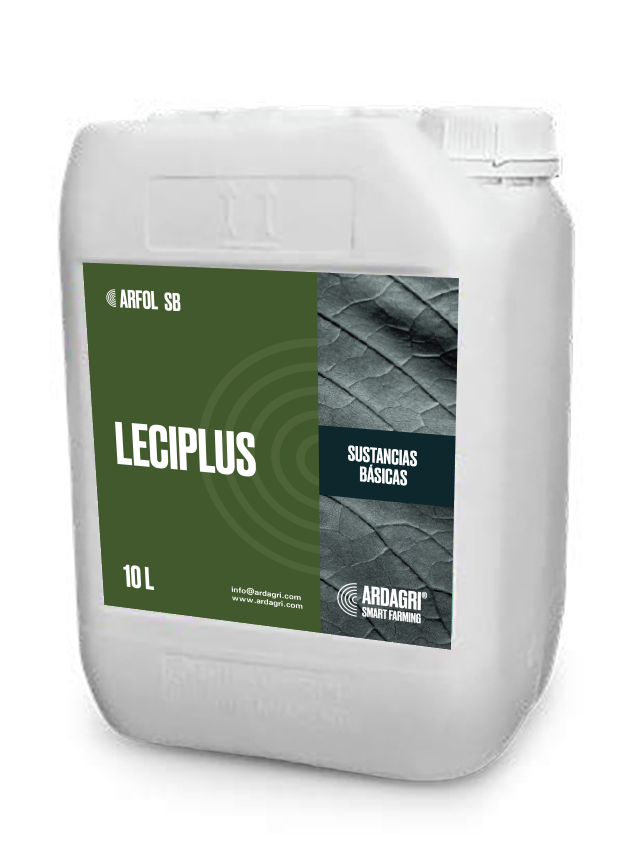
Lecithin is a naturally occurring phospholipid that acts on the cell membrane, improving its permeability and elasticity. In practical terms, it promotes more uniform cell multiplication, reduces the risk of cracking due to internal pressure, and improves cuticle integrity. Leciplus, formulated with lecithin, is applied during the peak cell division phase and up to harvest to build a more resistant and flexible epidermis with better post-harvest performance, and subsequently for the correct development of the fruit, wound healing, and fungicidal effects.
Micro-fissures, poor fruit set, and phosphorus (P) solubilizers
Microfissures are not always visible, but they open the door to pathogens and accelerate dehydration in cold storage. Their origin is often poor fruit set: deficient fruit set, resulting from a lack of key nutrients during flowering, produces fruits with a structurally weak epidermis from the beginning.
For a solid fruit set, the tree needs boron (B) (for pollen germination), zinc (Zn) (for auxin synthesis), calcium (Ca) (for the first cell divisions) and, most notably, assimilable phosphorus (P) for energy transfer in all growth processes. The lack of any of these nutrients at the critical moment can result in deficient fruit set, deformed fruits, or fruits with a structurally weak epidermis.
In basic soils, such as those in the Ebro Valley, the lack of available phosphorus (P) is one of the most significant limiting factors.
An innovative and sustainable tool to solve this—since traditional application is not effective enough for plant absorption—is the use of phosphorus-solubilizing bacteria (PSB). Microorganisms such as Bacillus megaterium or Pseudomonas fluorescens colonize the rhizosphere and release organic acids that locally acidify the environment and dissolve the phosphates retained in the soil. The result is phosphorus (P) available to the roots without the need to increase fertilizer doses, with the added benefit of improving long-term soil health.
Minimize split pits
Split pit is a common problem in early peaches and nectarines that stems directly from rapid and irregular growth. A fruit with a split pit loses commercial quality, is vulnerable to pathogens, and has a significantly reduced shelf life. Cold damage causes it, and they cannot be improved.
The factors that most effectively reduce it are: balanced calcium (Ca) and potassium (K) nutrition (avoiding K spikes in early stages), regular and homogeneous irrigation to prevent sudden water fluctuations, and proper fruit load control to regulate competition between fruits. In particularly sensitive varieties, it may be sensible to consider the application of growth regulators to homogenize development.
Fungicide protocol: the final shield
All nutritional effort can come to nothing if it is not supported by adequate phytosanitary protection. In stone fruit, the main post-harvest pathogens are Monilinia fructicola and M. laxa (brown rot), Botrytis cinerea (grey rot), and Rhizopus stolonifer, which is especially active in peaches during hot weather.
A solid protocol involves: rotating active ingredients from different FRAC groups to prevent resistance, applying preventive systemic, contact, and reactive fungicides before harvest, ensuring complete foliar coverage, and always respecting safety intervals. Complementing this with biocontrol products is an increasingly valued option, especially in integrated production.
Key points for stone fruit preservation
Improving stone fruit preservation is a task that begins in the soil and ends with harvest and post-harvest protocols. Correcting calcium (Ca) and phosphorus (P) blockage in basic soils, effectively managing the Ca/K ratio, promoting healthy cell division with lecithin (Leciplus), ensuring successful fruit set with assimilable nutrients, and protecting with preventive fungicides: these five pillars work together to bring resilient fruit to the market.
At Agroborges, we work hand in hand with our clients to design nutrition and protection programs tailored to each farm. If you would like us to review your strategy for this year’s campaign together, please contact our technical team.
