


What is the olive fruit fly?
The olive fruit fly (Bactrocera oleae) is a dipteran insect from the Tephritidae family. It is a pest that affects the olive tree (Olea europaea), making it a constant and direct threat to olive producers. The main types of damage include: decomposition of the fruit pulp, premature fruit drop, increased levels of free fatty acids in the oil, and the entry of bacteria and fungi.
Main characteristics:
- Insect 4–5 mm long, brown body and transparent wings.
- Egg: whitish, elongated.
- Larva: white worm that develops inside the fruit.
- Pupa: found in the soil or inside mummified fruits.
Life cycle of the olive fruit fly
The life cycle of the olive fruit fly is closely linked to climatic conditions and the development of the olive fruit. Factors that favor the pest include temperatures between 20–30 °C, high relative humidity, continuous fruit presence on trees, and a lack of natural predators.
Stages of the cycle:
-
Oviposition: the adult female lays a single egg per olive, piercing the skin with her ovipositor. She prefers medium to large olives. Egg-laying typically occurs from June to October, coinciding with the hardening of the stone. Under optimal conditions (20–25 °C), the egg hatches within 2–3 days.
-
Larva: after hatching, the white larva begins feeding on the olive pulp. This is the most destructive stage. The larva passes through three stages, growing and excavating tunnels inside the fruit. This phase lasts around 10–15 days, depending on temperature.
-
Pupa: once development is complete, the larva pupates. This may occur inside the olive (in high temperatures) or, more often, the larva drops to the ground and pupates in the soil (in colder temperatures or during the winter generation). This stage lasts around 10 days in summer but can extend to several months in winter.
-
Adult: the adult fly emerges from the pupa and feeds on sugary substances (molasses, sugars on leaf surfaces) before mating. The female can live for several weeks and lay hundreds of eggs, leading to overlapping generations throughout the year. In warmer climates, there can be up to 4–5 generations per year.
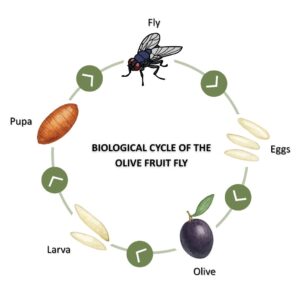
Life cycle of the olive fruit fly
Symptoms and detection of the olive fruit fly
Early detection is key for effective control. Symptoms vary depending on larval stage and infestation level.
When do symptoms appear?
From fruit set onwards, especially once the fruit reaches 0.5–1 cm in size. Peak activity usually occurs between August and October, depending on the region.
Visible symptoms:
- Small puncture on the fruit skin (oviposition mark).
- Brown or black discoloration around the puncture.
- Premature fruit drop.
- Tunnels and larvae inside the olive.
- Mummified or dried fruits.
Control strategies for the olive fruit fly
An Integrated Pest Management (IPM) approach is essential to keep Bactrocera oleae populations below economic damage thresholds.
1. Monitoring
Monitoring is the first step. The use of pheromone and food-attractant traps is essential to determine the optimal time for action.
2. Mass trapping
This method involves placing a high number of traps (usually 70–100 per hectare) to capture and eliminate as many adult flies as possible. Traps like McPhail or specific Bactrocera oleae models contain an attractant and an insecticide. This method is especially useful in areas with low pest pressure.
3. Insecticides
Several insecticides can be used to eradicate the pest:
- Scatto: contains deltamethrin, a synthetic pyrethroid with strong contact and ingestion activity. Foliar application: 50 ml/hl
- Epik: acts by contact and ingestion. Rapid translaminar movement allows control of insects on leaf undersides. It has strong systemic activity in both directions (from roots to plant and from treated leaves to other organs). Foliar application: 25 g/hl
- Kaiso® Sorbie™: pyrethroid insecticide with patented Sorbie™ Technology by Nufarm, allowing water-soluble granules to behave like an emulsifiable concentrate. Foliar application: 15 g/hl
- Esmalk®: a biological insecticide suitable for organic farming (MoA IRAC Group 11A), acting by ingestion. It produces a delta-endotoxin that affects the larval gut, stopping feeding and causing death by osmotic shock, septicemia, or starvation. Foliar application: 100 g/hl
- Hunter: insecticide, with registration, from the pyrethroid family. Foliar application: 20 ml/hl
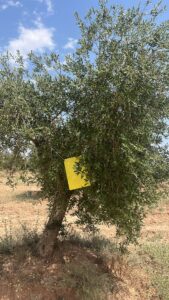
Monitoring of the olive fruit fly
At Agroborges, we work alongside farmers to offer effective, sustainable solutions tailored to each farm.
- We provide monitoring and mass-trapping kits.
- We offer personalized technical advice.
- We work with authorized, high-efficiency plant protection products.
- We support the transition to integrated or organic production systems.
Contact our technical team to develop a tailored olive fly control plan for your farm.
