

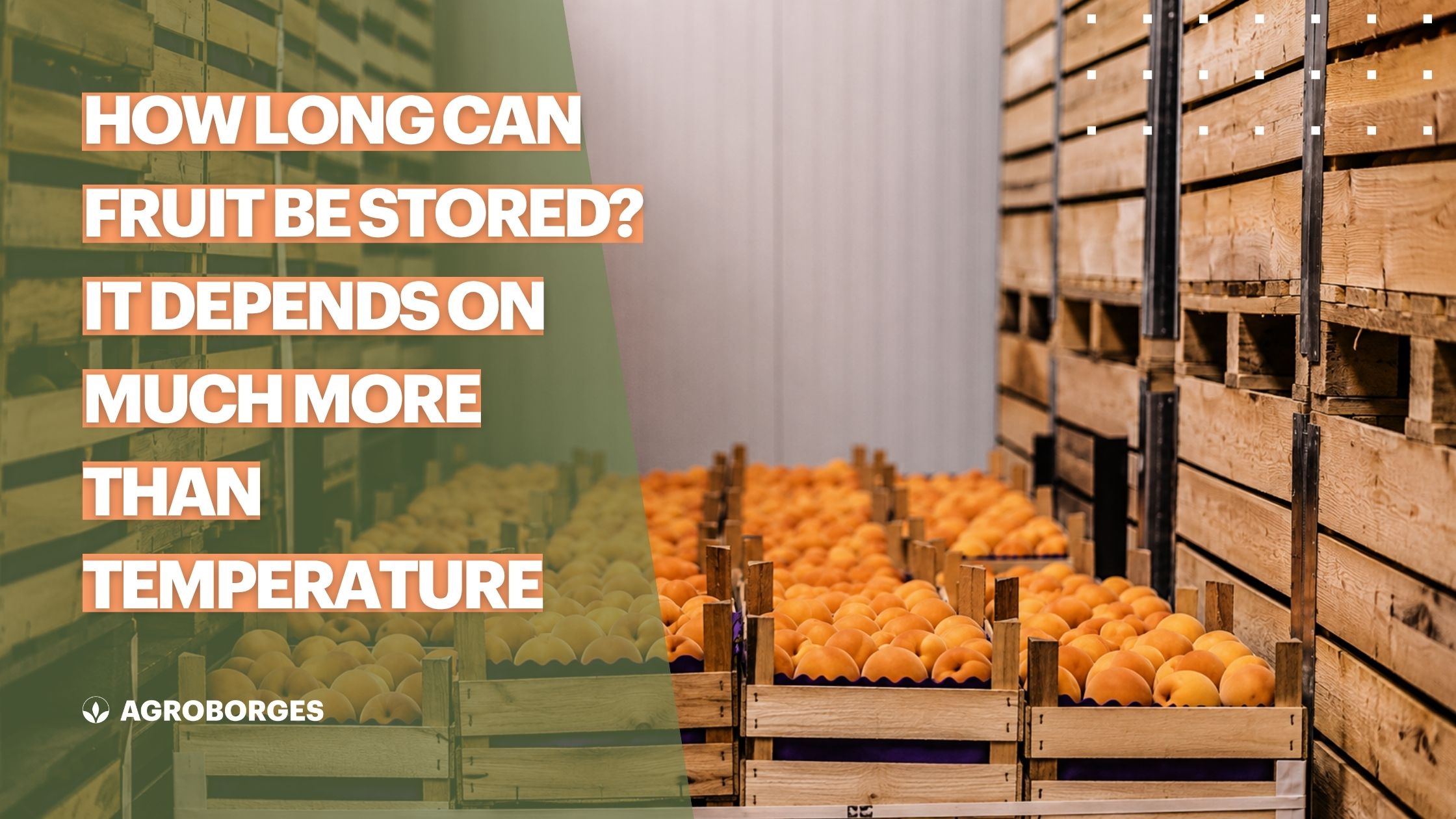
Weeks, or even months, can pass between the time fruit is harvested and the time it reaches the consumer’s table. Throughout this time, the fruit remains alive, continues to respire, and keeps ripening. The difference between a piece of fruit that arrives in optimal condition and one that is lost along the way depends mostly on the strategy followed in the field, but also during post-harvest.
In stone and pome fruit production across the Plana de Lleida and the Franja, peaches, nectarines, pears, and apples account for a large part of the post-harvest volume managed in the area’s facilities. It is precisely in this final stretch where much of the economic value of the entire campaign is at stake. Controlling fruit storage conditions is not a secondary technical option: it is a profitability decision.
In this article, we review the main variables that determine the post-harvest life of fruit, and the technologies available to extend it.
Why fruit continues to change after harvest
Once separated from the tree, fruit continues to carry out active metabolic processes. The core process is cellular respiration: cells consume oxygen and release carbon dioxide and heat. The faster this process occurs, the sooner the fruit ages.
There are fruits classified as climacteric (peaches, nectarines, pears, apples, plums) that exhibit an intense respiration peak during ripening, which is linked to high ethylene production. Others, the non-climacteric fruits (cherries, grapes, strawberries), ripen progressively and do not respond in the same way to exogenous ethylene.
Understanding which category each fruit falls into is the first step in deciding the appropriate storage protocol.
Temperature: The most decisive factor
Temperature is the variable with the greatest direct impact on respiration rate. Every 10°C increase in temperature doubles or triples the speed of metabolic processes (known as the Q10 coefficient). In other words, fruit stored at 20°C ages twice as fast as the same fruit at 10°C.
For most stone fruit in the area, optimal storage temperatures range between 0°C and 4°C, depending on the species and variety. Cooling must be rapid, and initiating it within the first few hours after harvest is highly recommended, as delays in precooling are one of the most frequent causes of quality loss in the field.
The phenomenon of chilling injury must be kept in mind: some peach and nectarine varieties are especially sensitive when stored between 2°C and 5°C for extended periods—a range that, paradoxically, is more problematic than 0°C. The main symptoms include internal browning, mealiness or loss of juiciness, and flesh bleeding. Knowing the tolerance of each variety is essential to establish the correct temperature range.
Relative humidity: Balancing dehydration and rot
Relative humidity in the storage chamber must be maintained at high levels, typically between 90% and 95%, to prevent weight loss from evaporation (known as transpirational loss). When fruit loses between 5% and 19% of its water weight, signs of wilting and loss of turgidity become visible.
However, high humidity comes with a trade-off: it encourages the development of pathogenic fungi such as Botrytis cinerea, Monilinia spp., or Penicillium spp., which find ideal conditions to proliferate in humid environments and skin micro-lesions. Striking a balance between sufficient humidity to preserve organoleptic quality and an environment that does not favor pathogens is one of the main technical challenges in post-harvest.
In many facilities, this balance is managed by combining humidity regulation with authorized post-harvest treatments, often applied on the packing line or in pre-storage baths.
Ethylene: The gas that accelerates ripening
Ethylene is a gaseous plant hormone (C₂H₄) that acts as a ripening signal in climacteric fruits. Its presence, even in concentrations of just a few parts per million (ppm), can trigger or significantly accelerate ripening and senescence processes.
In a storage chamber, ethylene accumulates via two pathways: through the internal production of the stored fruit itself and from external sources (machinery, decomposing products, or even other fruits in advanced stages of ripening). An ethylene concentration of just 1 ppm can already have measurable effects on the rate of ripening.
To minimize its effects, various strategies can be applied:
- Periodic ventilation of the chambers to dilute the accumulated gas.
- Ethylene absorbers (potassium permanganate or zeolite systems) that actively capture the gas.
- Ethylene perception inhibitors: 1-MCP (1-methylcyclopropene) is the most widely used product; it works by blocking the fruit’s ethylene receptors and effectively delaying ripening.
Modified and controlled atmosphere: actively extending shelf life
Modified atmosphere (MA) and controlled atmosphere (CA) technologies alter the gas composition inside the storage chamber or packaging, limiting oxygen availability and increasing CO₂, thereby slowing down the fruit’s respiration rate.
- Modified Atmosphere (MA): This is mainly applied in packaging. By sealing the fruit in a film with selective permeability, the fruit’s own respiration modifies the internal atmosphere of the package to equilibrium values that slow down ripening. It has a relatively low cost and is widely used in fresh-cut produce and for export.
- Controlled Atmosphere (CA): This is an active system that precisely regulates O₂ and CO₂ levels inside a hermetic chamber. Typical conditions for apples and pears range between 1–3% O₂ and 1–5% CO₂, well below the normal composition of air (21% O₂). Under well-managed CA conditions, some apple varieties can be stored for 9–12 months without significant loss of commercial quality.
An even more advanced variant is the Ultra-Low Oxygen (ULO) atmosphere, with O₂ levels below 1%, which allows the storage period of fruit to be extended even further in suitable varieties.
Other factors to consider for fruit storage
Beyond the four main variables, there are two additional factors that determine the final outcome:
- Quality at harvest time: no post-harvest technology can improve poorly harvested fruit. The stage of ripeness at the time of picking (evaluated by firmness, starch content, soluble solids, and acidity) is decisive for storage potential. Overripe fruit will enter the storage chamber at a disadvantage, regardless of the conditions applied.
- Hygiene and sanitary management of facilities: storage chambers can act as a source of fungal inoculum if not managed correctly between campaigns. Cleaning and disinfecting walls, floors, cooling systems, and crates is a preventive measure that is often undervalued and has a direct impact on the incidence of rot.
Basic checklist for efficient post-harvest management
- Initiate precooling within the first 4–6 hours post-harvest.
- Maintain chamber temperature within the specific range for each variety.
- Control relative humidity and ensure air circulation.
- Actively manage ethylene (ventilation, absorbers, or inhibitors).
- Separate lots of different maturity levels to prevent ethylene cross-contamination.
- Clean and disinfect chambers before each campaign.
- Evaluate the stage of ripeness at harvest to estimate fruit storage potential.
At Agroborges, we stand by your side during post-harvest
At Agroborges, we understand the specific characteristics of stone and pome fruit in the Plana de Lleida and the Franja. If you are planning your post-harvest campaign or want to review your current treatment and storage protocols, our technical team can help you fine-tune every variable with a free audit. Fill out the form to check availability.
