

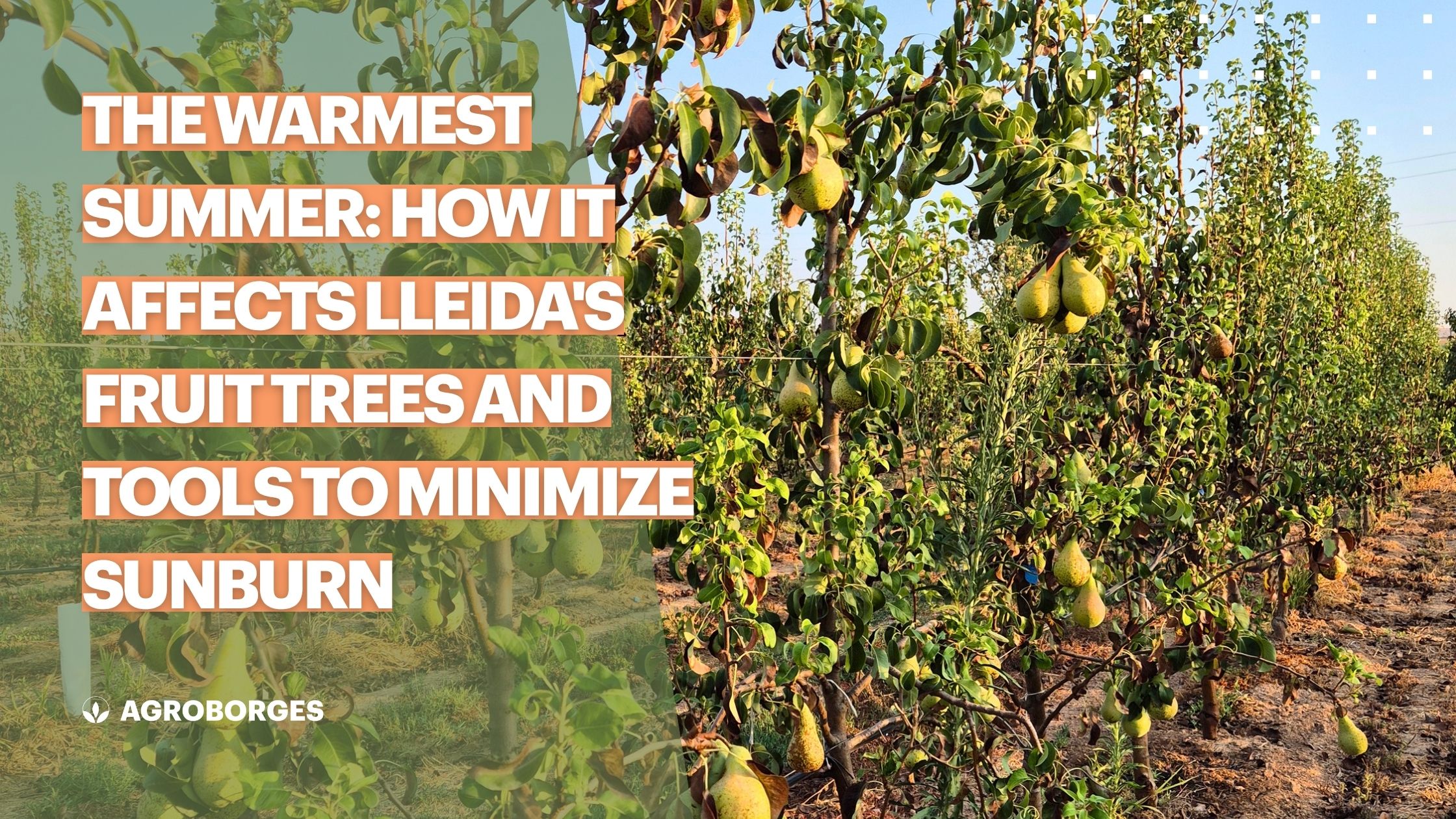
The summer of 2026 has gone down in history as the warmest ever recorded in Catalonia. This is confirmed by the Servei Meteorològic de Catalunya, with a temperature anomaly equal to or greater than +3 °C compared to the 1991–2020 period across nearly 85% of the territory. For those working the land in the Lleida plain, this figure is no simple statistic. It has translated into harvests advanced by three weeks, pear sizes reduced by up to 40%, and almonds harvested ten days earlier than usual.
The trend, in fact, recurs at every scale. AEMET ranks this summer as the warmest recorded in Spain since records began in 1961, and the World Meteorological Organization has confirmed that July 2026 was tied with July 2024 as the warmest July ever recorded on the planet since 1850. Catalonia is not, therefore, experiencing an isolated episode.
The heatwaves of June, July, and August have tested every crop in the region (stone fruit, pome fruit, nuts, vineyards, and olive groves), and each has responded differently depending on the irrigation system, variety, and prior condition of the farm. Below, we review what official data indicates, how it has been felt in the field, and which measures have proven to work best against the campaign’s most widespread damage: sunburn.
An unprecedented summer
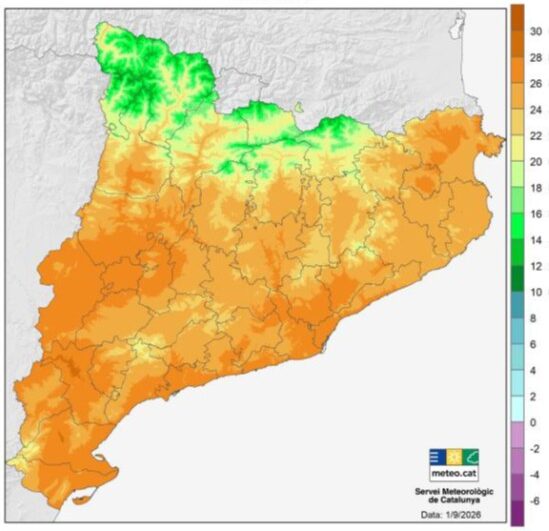
The climate progress bulletin from the Meteorological Service of Catalonia confirms that the summer of 2026 has clearly exceeded previous records from the summers of 2022 and 2003. 95% of the XEMA (Automated Meteorological Station Network) stations with over 20 years of data recorded this summer as the warmest in their series. Furthermore, across all historical series of 75 years or more—including the Fabra Observatory in Barcelona (113 years of data) and the Ebro Observatory (122 years)—2026 ranks first.
In the Lleida plain, the combination has been particularly harsh, as extreme heat and severe drought coincided. According to meteo.cat, the season has been very dry across extensive areas of Ponent, with accumulated precipitation below 15% of the reference climate value in some zones. Mollerussa ended the summer with only 1.4 mm accumulated and a dry spell already exceeding 111 consecutive days without significant rain. Camarles, in Baix Ebre, did not even reach 2 mm throughout the entire season.
All three months contributed equally. June was very warm, with the first heatwave occurring between June 21 and 24. July set a new absolute maximum temperature record at the Fabra Observatory, reaching 40.9 °C on the 8th. And August turned out to be the warmest ever measured in Catalonia, with a persistent heat event between the 9th and the 19th.
Why Has This Summer Hit Crops So Hard?
The determining factor has not been daytime maximum temperatures alone, but rather the persistence of the heat and the lack of nighttime relief. The Can Bruixa monitoring station in Barcelona recorded 59 torrid nights—with temperatures remaining at or above 25 °C—surpassing the previous record of 51 set in 2003. This phenomenon has also been felt across the Lleida plain, where crops were deprived of a sufficient nighttime thermal buffer to recover from the stress accumulated throughout the day.
At an agronomic level, this combination triggers two main effects. The first is the closure of leaf stomata as a defense mechanism against dehydration, which reduces photosynthesis and halts fruit development right at critical sizing stages. The second is the accentuation of transpiration and water loss from the fruit itself, resulting in smaller fruit sizes, sunburn, and, in extreme cases, the desiccation of entire leaves.
Added to this, XEMA recorded 20 days with temperatures equal to or above 40 °C at some point in Catalonia, mostly concentrated in Segrià and Ribera d’Ebre. You would have to go back to 2014 to find a year without a single recording of this threshold. The prior accumulated drought in some farms, especially rainfed ones, further restricted the trees’ capacity to cope with stress.
How It Has Affected Each Crop in the Lleida Plain
- Peaches and Nectarines. The campaign started with a solid predicted volume, but the sustained heat has reduced fruit size and caused dehydration issues that lower its commercial value at origin. Unió de Pagesos has warned that on peach and nectarine farms, production cost increases close to 25%, combined with low prices, could leave some holdings without any margin to cover expenses this season.
- Pears. This is likely the hardest-hit crop. The Conference variety, the most widespread in Catalonia representing 40% of production, suffered sustained thermal stress with temperatures exceeding 36 °C for weeks at a time. The outcome has been leaf scorch, drying leaves, and an estimated production decline of between 40% and 80% across more than 60% of Conference orchards. In contrast, the Limonera pear, harvested earlier, benefited from the heat and the water reserves left by a rainy spring, reaching the market with larger-than-usual sizes.
- Apples. Volume forecasts remain similar to last year’s, but high temperatures caused spots and sunburn on a significant portion of the output. This hampers fresh market commercialization and forces growers to redirect part of the harvest to secondary channels.
- Almonds. The harvest was brought forward by about ten days due to heatwaves accelerating the premature opening of the hull before the nut could fully mature. Almonds located in the upper parts of the canopy, most exposed to the sun, failed to develop properly. Nevertheless, the sector expects yields comparable to those of the previous campaign.
- Grapes. The 2026 grape harvest has been, for many wineries across the Lleida plain and DO Costers del Segre, the earliest in their history, arriving up to a month and a half ahead of schedule for certain varieties. DO Costers del Segre anticipates wrapping up the campaign roughly three weeks earlier than usual. Despite the stress, the lack of rainfall maintained excellent grape health, and wineries expect volumes similar to previous years thanks to supplemental irrigation and adaptations in canopy management, leaving more leaf cover to shade the clusters from direct radiation.
- Olives. Several months remain until the harvest begins in November, but the sector is approaching the upcoming campaign with caution. Spring flowering conditions combined with accumulated water stress on rainfed farms in counties like Les Garrigues and El Segrià are factors that have historically pushed olive oil yields down in comparable years, though it is still too early to make definitive forecasts.
Sunburn, the Common Denominator of the Campaign
If a single type of damage sums up this summer, it is sunburn. It appears on pears, apples, grapes, and the most exposed almonds, and its impact goes beyond the visible lesion. Sunburn reduces the commercial value of the fruit, forces growers to sort out part of the harvest before it reaches the packing house, and, in the most severe cases, leaves fruit completely unsuitable for the fresh market.
When direct solar radiation heats the fruit’s epidermis above a critical threshold and the plant cannot dissipate this heat through transpiration—because the stomata are closed or water is unavailable—the tissue deteriorates. This is why sunburn intensifies in the exact conditions experienced this summer, with high radiation, extreme temperatures, and limited water availability occurring simultaneously.
The good news is that this is predictable, and therefore manageable, damage. The response, however, does not rely on a single measure, but on combining three that act at different times and levels.
Three tools to mitigate sunburn
- Physical protection of the plantation: shading nets serve as the primary and most effective barrier against direct radiation. They lower the temperature of both the fruit and the environment under the canopy, reduce the tree’s water demand, and prevent the radiation spikes that cause sunburn. This is a structural investment that requires advance planning to evaluate the appropriate shading percentage for each crop and variety, as excessive shading can negatively impact color development and ripening.
- Physical protection of the fruit: when shading nets are not feasible or additional reinforcement is required, solar protectants and foliar-applied thermoregulators come into play. They work by forming a film over the fruit’s epidermis that reflects a portion of the radiation and lowers its surface temperature, mitigating the risk of sunburn without interfering with gas exchange. Anticipation is key here. Applications must be carried out prior to forecasted heat events, rather than after visible damage has occurred, maintaining coverage through reapplications based on rainfall and fruit growth.
- Biostimulation and potassium nutrition: the third pillar involves building the plant’s resistance from within. Biostimulant treatments help maintain physiological activity under thermal stress conditions, while adequate potassium availability enhances stomatal regulation and the plant’s water balance—factors directly linked to heat tolerance. Ensuring an adequate supply of potassium during fruit development stages offers one of the most cost-effective protective measures.
The combination of these three levels is what makes the difference. Nets reduce incoming radiation, protectants lower the temperature of exposed fruit, and biostimulation strengthens the plant’s capacity to manage stress. In a season like 2026, relying on just one of these approaches has clearly proven insufficient.
Adapting management to a climate that is no longer exceptional
Beyond sunburn, the common denominator across all crops has been the need to adapt agronomic practices on the fly. Several farms moved harvest hours to the early morning to avoid peak heat hours, and some wineries are already studying lighting systems to harvest at dawn or during the night in the near future.
In terms of irrigation, the primary response has been to reinforce supplemental irrigation during critical fruit sizing stages and periods of intense heat, always prioritizing water efficiency in a context of limited availability. In vineyards, retaining more canopy cover on the vines rather than over-leafing has proven to protect grapes from direct solar radiation without compromising ripening.
Therefore, we recommend reviewing irrigation and nutrition planning well in advance, adjusting dosages according to the actual needs of each phenological stage, and evaluating products that enhance the plant’s tolerance to water and thermal stress. It is also time to assess, crop by crop, whether protection against sunburn needs to be reinforced on particularly sensitive varieties such as Conference, and to check the health status of the trees prior to winter dormancy.
Speak with our technical team
At Agroborges, we have been working alongside farmers in Lleida and the Franja de Ponent for decades, and we know that every campaign with this level of climate demand requires decisions tailored to each farm and crop. If you want to review the condition of your crop or need advice on how to protect it, call us or fill out the contact form to speak with our technical team.
Sources: Servei Meteorològic de Catalunya (Avanç del butlletí climàtic de l’estiu del 2026), AEMET, Organització Meteorològica Mundial, Unió de Pagesos, ACN, Segre, Nació Digital i Ràdio Balaguer.
